6 min read

How to Evaluate Aircraft Preconditioned Air Solutions

How to Evaluate Aircraft Preconditioned Air Solutions

Selecting the right preconditioned air (PCA) solution involves more than comparing cooling capacity and price. One must determine how the equipment will fit their aircraft mix, available electrical infrastructure, maintenance processes, and broader aircraft ground support equipment fleet.

The wrong unit may be difficult to position, incompatible with available facility power, expensive to maintain, or unable to deliver sufficient airflow under actual ramp conditions. The right system can improve working conditions, reduce aircraft turnaround time, support maintenance productivity and efficiency, and decrease unnecessary operation costs.

This practical guide outlines the most important factors to consider when evaluating preconditioned air units and selecting a manufacturer.

1. Define the Actual Aircraft PCA Application

The first step is to distinguish between two fundamentally different types of preconditioned air solutions.

A pressurized PCA system connects to an aircraft’s ground air-conditioning (GAC) connection and supplies conditioned air through the aircraft’s environmental-control ducting. These systems are commonly associated with airline gates and larger commercial aircraft.

A free-flow aircraft pre-cooling system delivers conditioned air through an open cabin door, baggage door, access panel, equipment-bay opening, or maintenance hatch. This configuration is particularly useful for:

  • Business and regional aircraft
  • Helicopters
  • Maintenance hangars
  • Avionics and equipment-bay work
  • Cabin refurbishment and inspection
  • Aircraft parked away from a passenger gate
  • Applications without a compatible ground air-conditioning connection

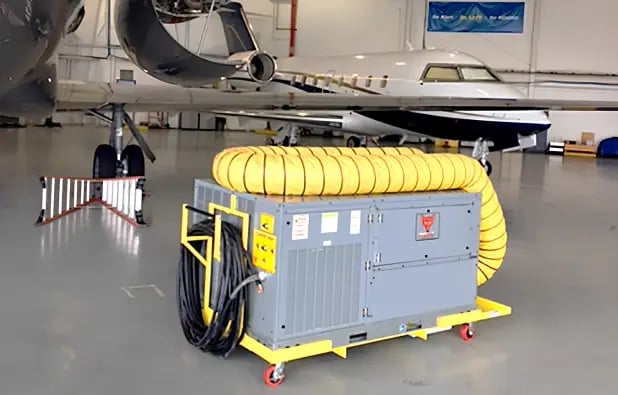
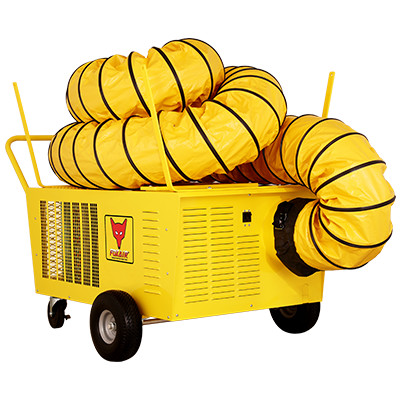
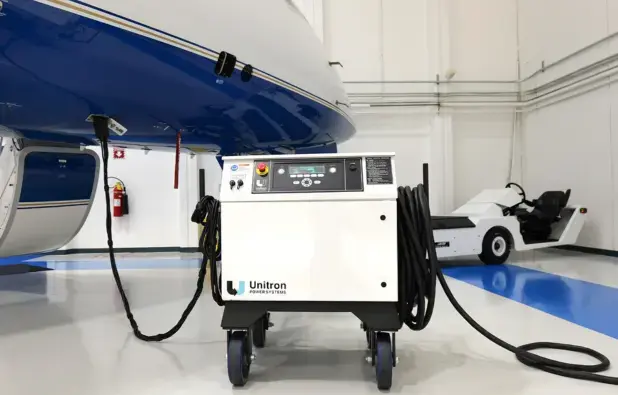
Unitron’s FoxAir® products are designed as portable, free-flow preconditioned air units for aircraft pre-cooling and maintenance operations. They deliver conditioned air through an open door or hatch rather than pressurizing an aircraft cabin through a GAC connection.

2. Match Cooling Capacity to the Aircraft and Operating Environment

Cooling capacity is generally expressed in British thermal units per hour, or BTU/hr. A larger aircraft normally requires more capacity, but aircraft size is only one part of the calculation.

Buyers should also consider:

  • Outside air temperature
  • Solar loading on the fuselage
  • Cabin volume and insulation
  • Door and hatch configuration
  • Required hose length
  • Desired cool-down time
  • Number of technicians working inside the aircraft
  • Heat generated by lights, test equipment, and avionics
  • Whether the aircraft is indoors or on an exposed ramp

A unit that performs adequately inside a shaded hangar may not provide the same results on a ramp in Texas, Arizona, Florida, or the Middle East.

FoxAir configurations currently include approximately 24,000, 47,000, and 59,000 BTU models. This range allows operators to select equipment for applications ranging from helicopters and smaller business aircraft to large business jets and regional aircraft.

3. Evaluate Airflow as Well as BTU Capacity

Cooling capacity and airflow are related, but they are not interchangeable. BTU capacity indicates how much heat the refrigeration system can remove. Airflow, typically stated in cubic feet per minute, indicates how much conditioned air the unit can move into the aircraft.

Insufficient airflow can result in poor air distribution, slow cabin cooling, or inadequate circulation through a long delivery hose. Conversely, high airflow without sufficient refrigeration capacity may move a large volume of air without reducing the cabin temperature as effectively as required.

When comparing preconditioned air solutions, request both:

  • Rated cooling capacity in BTU/hr
  • Nominal airflow in CFM

Unitron’s FoxAir 60 provides a 480 CFM air-movement system. The FoxAir Max LP provides approximately 1,570 CFM, while the FoxAir Max provides approximately 1,820 CFM.

4. Confirm Preconditioned Air Unit Compatibility with Available Facility Power

When selecting an aircraft PCA system, first confirm the:

  • Available input voltage
  • Single-phase or three-phase service
  • Frequency
  • Required current
  • Receptacle and plug configuration
  • Circuit-breaker capacity
  • Maximum acceptable input-cable length
  • Whether the unit will operate in multiple hangars or locations

Smaller aircraft pre-cooling systems may operate from relatively simple facility power, while larger units may require higher-voltage single- or three-phase service. The FoxAir 60 requires only 20-amp service. FoxAir Max LP and FoxAir Max configurations are available for 208–575 VAC, single- or three-phase, 60 Hz power sources.

Airport and MRO teams should compare these requirements with the power available at every intended operating location, not just the primary hangar.

5. Examine Hose Configuration and Pressure Loss

The air-delivery hose is part of the system, not merely an accessory. Hose diameter, length, insulation, routing, and bend radius can significantly affect performance. Long hoses and sharp bends can restrict airflow and increase thermal losses before the conditioned air reaches the aircraft.Bottom-2.2

During the evaluation, determine:

  • Required hose diameter
  • Standard and optional hose lengths
  • Whether extension couplings are available
  • How the hose connects to the preconditioned air unit
  • How the hose will be positioned at the aircraft
  • How the hose can be stored without damage

FoxAir systems use a steel-reinforced, 10-inch-diameter air-delivery hose, with multiple length options depending on the selected model.

6. Consider Mobility and GSE Fleet Fit

Preconditioned air units must operate safely around aircraft, hangars, personnel, ground power units, and other aircraft ground support equipment.

Evaluate the PCA unit’s:

  • Overall dimensions
  • Height and aircraft-clearance requirements
  • Turning radius
  • Tire and caster design
  • Braking or locking provisions
  • Towability
  • Towing-speed limitation
  • Hose and cable storage
  • Access to service panels
  • Ability to pass beneath wings or passenger boarding bridges

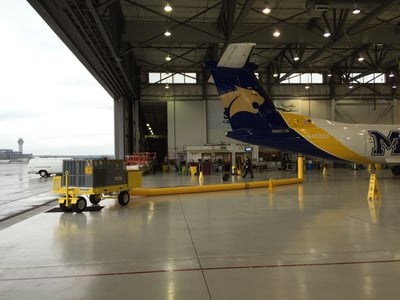
A low-profile design may be preferable where vertical clearance is limited. A larger towable configuration may be better for outdoor ramp use or movement among multiple aircraft positions. The FoxAir Max LP is mounted on a low-profile trolley for applications such as maintenance hangars and areas beneath passenger boarding bridges. The larger FoxAir Max uses oversized tires and can be towed at speeds up to 5 mph.

7. Account for Humidity and Condensate Management

Aircraft pre-cooling does more than reduce air temperature. Refrigerated systems also remove moisture from the air. This can improve maintenance technician comfort and help control humidity inside cabins and equipment compartments. Applicable questions include:

  • How is condensation collected?
  • What is the tank capacity?
  • Is the tank level visible?
  • Can a drain hose be connected?
  • What happens if the tank becomes full?
  • How is freeze-up prevented?
  • How frequently must the system be drained in humid environments?

FoxAir Max LP includes an integral 21-gallon visible condensation-storage tank with a drain valve. Condensate tanks, drain-hose kits, and freeze-protection options are available for selected configurations. Condensate management can become a significant operational issue in hot, humid climates.

8. Determine Whether Heating Is Required

Although aircraft pre-cooling is typically the initial requirement, MRO facilities in colder climates may also need heating.

A combined heating and cooling system can support:

  • Winter maintenance
  • Cabin refurbishment
  • Avionics work
  • Interior installation
  • Pre-delivery inspections
  • Technician comfort during extended maintenance events

Optional electric heating is available on selected FoxAir configurations. The FoxAir Max LP can be equipped with an 18 kW heater, while the FoxAir Max offers a 20 kW heating option. Buyers should confirm whether the heating function affects required electrical service and whether the facility has sufficient capacity to operate the heater at full output.

9. Review Noise and Technician Usability

Aircraft maintenance operations frequently require communication among technicians working inside and outside the aircraft. Excessive equipment noise can interfere with verbal communication, troubleshooting, and extended maintenance work.

Evaluate:

  • Published sound level
  • Measurement distance
  • Compressor cycling
  • Fan noise
  • Operator-control complexity
  • Remote-control capability
  • Filter access
  • Visibility of operating status
  • Ease of connecting hoses and cables

FoxAir Max LP and FoxAir Max are rated at approximately 78 decibels and feature one-switch operation. The smaller FoxAir 60 includes an infrared remote control with a display.

10. Evaluate Preconditioned Air Unit Maintainability and Vendor Support

The total cost of ownership depends heavily on whether the equipment can be maintained using locally available skills and components. Ask prospective manufacturers:General-FoxAir-50.60-Resized-400px400px

  • Can a qualified commercial HVAC technician service the refrigeration system?
  • Are diagnostic procedures and manuals available?
  • Are filters washable or replaceable?
  • How accessible are compressors, coils, fans, and electrical components?
  • How can I get replacement parts?
  • What technical support is available?
  • How quickly can the vendor respond to an aircraft-on-ground or maintenance-critical problem?

FoxAir Max LP and FoxAir Max use high-efficiency scroll compressors and generally available refrigerant systems and are designed so that technicians with standard HVAC tools can perform routine service.

11. Compare PCA Equipment with the Broader Ground-Support Strategy

Preconditioned air units are often operated alongside 400 Hz AC, 28 VDC, or 270 VDC ground power units. A coordinated ground-support strategy can help an organization:

  • Reduce unnecessary APU operation
  • Limit wear on onboard air-conditioning systems
  • Improve technician working conditions for enhanced productivity
  • Support simultaneous aircraft power and cooling
  • Standardize equipment support
  • Simplify operator training
  • Improve hangar and ramp utilization efficiency

When comparing vendor solutions, determine whether they understand both the environmental-control requirement and the aircraft electrical-power requirements.

A Practical Aircraft Preconditioned Air Unit Evaluation Checklist

Before selecting a supplier, document the following:

  1. Aircraft models and cabin sizes
  2. Free-flow or pressurized-air requirement
  3. Required cooling and heating capacity
  4. Expected ambient temperature and humidity
  5. Required airflow and cool-down time
  6. Available facility voltage, phase, frequency, and current
  7. Required air-hose and input-cable lengths
  8. Height, mobility, and towing requirements
  9. Condensate-management procedure
  10. Noise and operator-control requirements
  11. Local maintenance capabilities
  12. Parts, warranty, and technical-support expectations
  13. Compatibility with existing ground power units and GSE procedures

Selecting the Right Preconditioned Air Solution

There is no single aircraft PCA configuration that is correct for every airport or maintenance organization.

A smaller portable unit may be ideal for helicopters, turboprops, and light business aircraft. A low-profile system may be the best choice for constrained hangar environments. A higher-capacity towable unit may be required for outdoor aircraft pre-cooling or larger business and regional aircraft.

The best selection process begins with the application—not a catalog number.

Unitron offers FoxAir free-flow preconditioned air solutions in multiple cooling capacities, mobility configurations, and optional heating packages. These systems are designed to support aircraft pre-cooling and maintenance operations while complementing the organization’s broader aircraft ground support equipment strategy.

To evaluate a FoxAir configuration, provide Unitron with the aircraft model, operating environment, available facility power, required hose length, and intended use. That information allows the application to be reviewed against the appropriate cooling capacity, airflow, and equipment configuration.

New call-to-action